

ADNOC Approved Contractor In The UAE
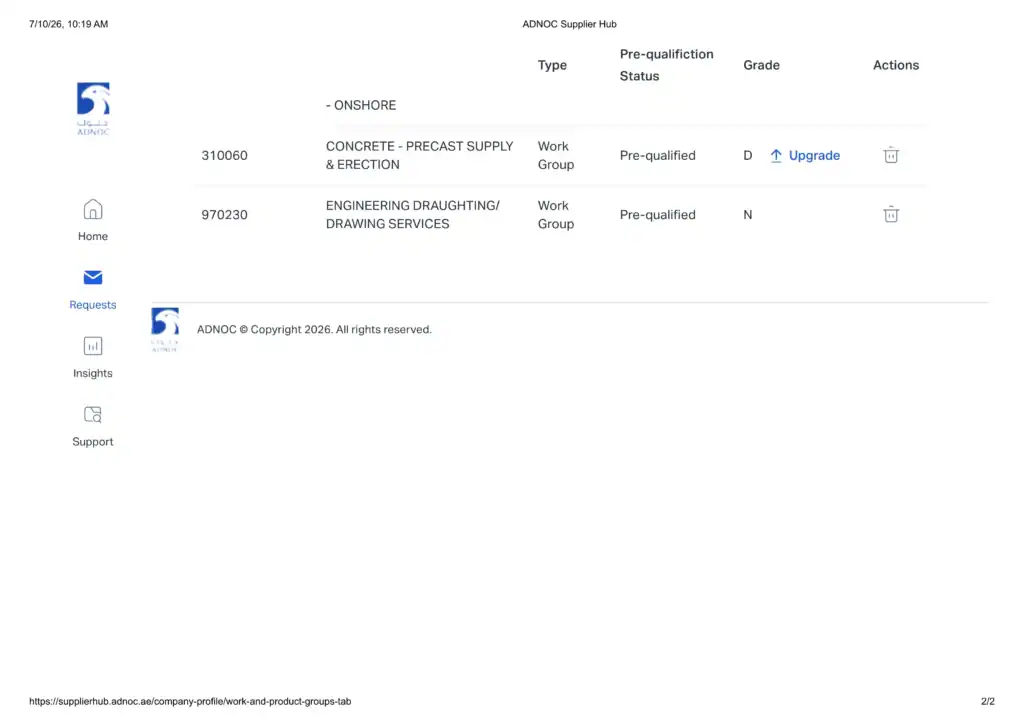
UCES Middle East is a registered ADNOC-approved contractor and ADNOC ICV-certified vendor. Here’s exactly what that approval involves, how it’s earned, and how your procurement team can verify any contractor’s status before awarding a project.
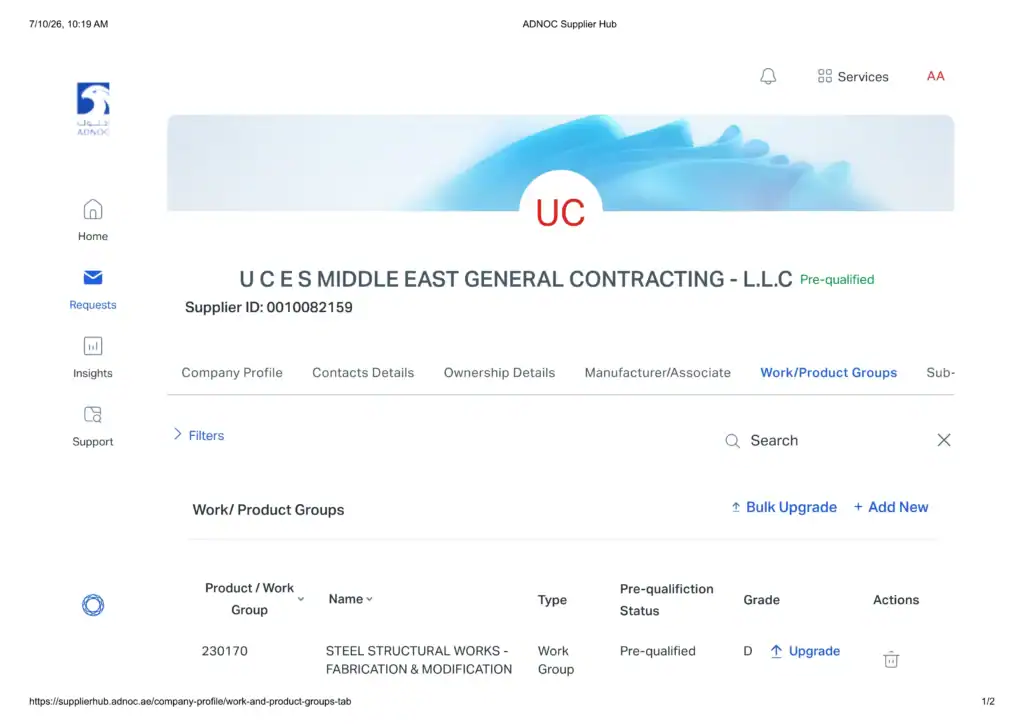
ADNOC Approved Contractor
Registered and prequalified to deliver EPC and civil works on ADNOC-linked projects.
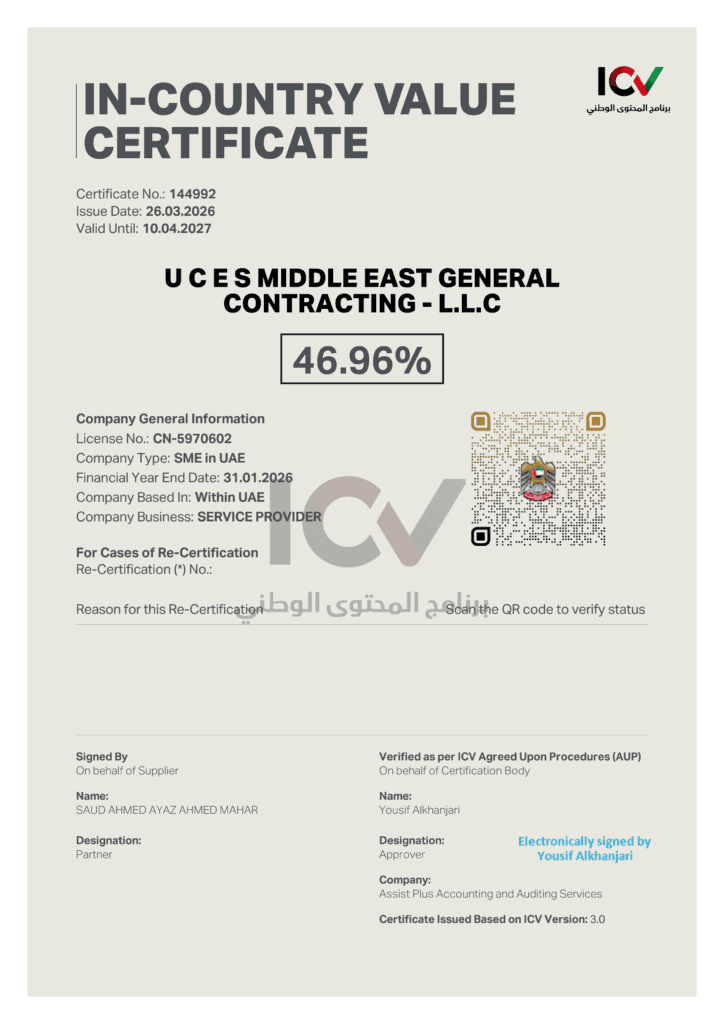
ADNOC ICV Certified
Certified under ADNOC’s In-Country Value program, scored on local economic contribution.
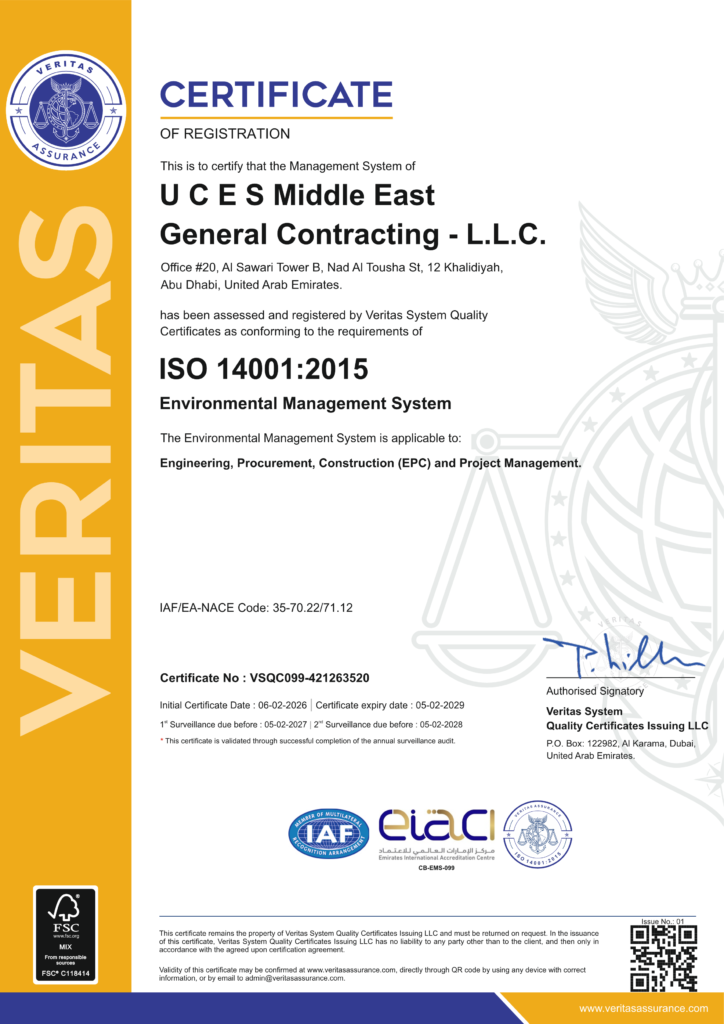
ISO 9001:2015 Certified
Quality management system independently audited and certified by EIAC.
“ADNOC Approved” Gets Claimed A Lot. It Should Be Verified, Not Assumed.
If you’re a procurement manager, project manager, or facility owner sourcing a contractor for an ADNOC-linked or oil & gas project in the UAE, you’ll see the phrase “ADNOC approved” on almost every contractor’s website. Not all of them can back it up. Genuine ADNOC approval is a documented, auditable status earned through ADNOC’s own registration and prequalification system — not a marketing phrase.
UCES Middle East holds active ADNOC Approved Contractor status and ADNOC ICV certification, alongside ISO 9001:2015 certification audited by EIAC. This page walks through what that approval actually requires, how ICV certification differs from base approval, and — because we’d rather you make an informed decision than take our word for it — exactly how to verify any contractor’s ADNOC status yourself.
Whether you’re vetting UCES or a shortlist of contractors for a civil, mechanical, or steel fabrication scope, this is the information your compliance team will actually ask for.
How A Contractor Actually Becomes ADNOC Approved
ADNOC’s vendor system runs through its Supplier Portal (built on the Ariba platform) and applies across every ADNOC Group Company — Onshore, Offshore, Drilling, Distribution, LNG, Refining and others. Registration is not a one-click signup; it’s a structured evaluation. Here’s the sequence contractors go through:
Supplier Registration
The company registers on ADNOC’s Supplier Portal with a valid UAE trade license, company profile and core legal documentation, choosing the correct category — Contractor, Vendor, Service Provider or Manufacturer. Construction and engineering firms register specifically under the Contractor category.
Prequalification & SPQ Submission
The company completes a Supplier Profile Questionnaire (SPQ) covering technical capability, financial stability, HSE track record, and quality systems – typically supported by ISO certifications, safety statistics and past project references.
Evaluation, Including On-Site Assessment
ADNOC assesses the submission against its technical, financial and HSE benchmarks, which can include a site or facility evaluation before approval is granted.
Approved Vendor Status & Unified ID
Successful applicants receive a unique ADNOC Unified ID and are added to the approved vendor list, unlocking eligibility to bid on ADNOC tenders and RFPs.
Ongoing Renewal
Approval isn’t permanent. Prequalification typically needs renewal every one to two years, with documentation kept current – a contractor whose certificate has quietly lapsed is a real risk your compliance team should check for.
ADNOC Approval And ICV Certification Are Not The Same Thing
Base ADNOC approval qualifies a contractor to bid at all. In-Country Value (ICV) certification, launched by ADNOC in 2018, is a separate score layered on top of that — measuring how much a contractor contributes back to the UAE economy through local employment, Emiratisation, local manufacturing and local spend.
That ICV score is now used directly in tender evaluation, not just at ADNOC but increasingly at Aldar, Etihad Rail, ADDED and other government-linked entities. A contractor can technically be “ADNOC approved” without holding a strong ICV score, which matters if your project or your own client requires ICV-weighted vendors.
- UCES holds both credentials – approved contractor status and ICV certification.
- ICV scoring can directly affect tender evaluation outcomes on qualifying projects.
- Ask any shortlisted contractor for their current ICV certificate, not just an “ADNOC approved” claim.
How To Verify A Contractor’s ADNOC Status Yourself
Don’t take a homepage badge at face value. These are the checks a compliance or procurement team can run in a few minutes:
- Ask for the ADNOC Unified ID issued through the Supplier Portal – a genuinely approved contractor will have one on file and be able to share it.
- Request a current prequalification certificate with a visible expiry date – remember, these lapse every one to two years.
- Ask for the ICV certificate separately if your project requires ICV-weighted vendors – it’s not automatically included with base approval.
- Cross-check the trade license and registered activities against the scope you’re procuring – a contractor licensed for “trading” isn’t automatically licensed for civil or mechanical construction.
- Confirm ISO and HSE documentation is current, not just referenced – ask for the certificate and its audit body (UCES’s is issued by EIAC).
Red Flags That An “ADNOC Approved” Claim Doesn’t Hold Up
Having reviewed this process from the contractor side, these are the patterns that should make a procurement team pause:
Vague On Specifics
A contractor who can’t produce a Unified ID or certificate number when asked, only a general “we’re approved” statement.
No Expiry Date Shown
Certificates presented without a visible validity period – approval that was true two years ago isn’t necessarily true today.
Wrong Registration Category
A company registered as a Vendor/Supplier taking on Contractor-scope construction work it isn’t licensed to perform.
Approval Without ICV
Fine for some scopes, a problem if your project specifically requires ICV-weighted vendors and the contractor doesn’t hold that certificate.
What An Unverified Contractor Actually Costs You
Tender Disqualification
Projects requiring ADNOC-approved or ICV-scored vendors can disqualify a contractor mid-process if credentials don’t hold up.
Compliance Delays
A lapsed certificate discovered post-award means re-verification, paperwork, and schedule slippage you didn’t budget for.
HSE & Quality Risk
Approval exists partly to filter for safety and quality track record – skipping verification skips that filter too.
Reputational Exposure
Your own client or auditor can trace subcontractor compliance back to you – an unverified vendor becomes your problem too.
Services Backed By Our ADNOC-Approved, ICV-Certified Status
ADNOC Approved Contractor: Common Questions
What does “ADNOC approved” actually mean?
It means the contractor has completed ADNOC’s supplier registration and prequalification process – covering technical capability, financial stability, and HSE and quality compliance – and appears on ADNOC’s approved vendor list with a Unified ID.
Is ADNOC approval the same as ICV certification?
No. ADNOC approval qualifies a contractor to bid. ICV (In-Country Value) certification is a separate, additional score measuring the contractor’s contribution to the UAE economy, used in tender evaluation on qualifying projects.
How long does ADNOC approval last?
Prequalification certificates are typically valid for one to two years and must be renewed to remain active – it’s worth confirming a contractor’s certificate is current, not just historically approved.
Can I verify a contractor’s ADNOC status myself?
Yes. Ask for their ADNOC Unified ID, a current prequalification certificate with visible expiry date, and (if relevant to your project) their ICV certificate. A genuinely approved contractor will provide these without hesitation.
Does ADNOC-approved status extend to subcontractors?
Not automatically. Each entity performing work typically needs its own registration and compliance documentation – it’s worth confirming this explicitly if a contractor plans to subcontract part of the scope.
Is UCES Middle East ADNOC approved and ICV certified?
Yes. UCES Middle East holds active ADNOC Approved Contractor status and ADNOC ICV certification, alongside ISO 9001:2015 certification audited by EIAC.
What’s the difference between the Contractor, Vendor, and Service Provider registration categories?
ADNOC separates registration by activity type: Contractors deliver construction, engineering or project-based works; Vendors/Suppliers provide goods or equipment; Service Providers cover logistics, IT and other support services. UCES is registered under the Contractor category, matching our civil, mechanical and fabrication scope.
Work With A Contractor You Don’t Have To Take On Faith
Request our current ADNOC approval and ICV certificates directly, or send us your project scope and we’ll respond with a proposal and full compliance documentation together.
Call +971 50 944 6135 | Office #20, Al Sawari Tower B, Nad Al Tousha St, Khalidiyah, Abu Dhabi, UAE
🏗️ UCES Middle East General Contracting LLC — Abu Dhabi, UAE | ADNOC Approved Contractor | ADNOC ICV Certified | ISO 9001:2015 Certified, audited by EIAC.